Teaching with memes
Use a meme to start a question about a lesson, then ask students to explain the idea behind it. A funny caption alone cannot show you what they understand.

In this article
What can a meme add to a lesson?
A captioned picture gives the class something specific to discuss. Ask students to identify the concept, explain the connection and point out what the picture leaves out. Their answers give you material to question and correct.
You can use a meme as an opening question, a review prompt or a student assignment. Teach the necessary facts first, choose a reference the class can follow, and keep the explanation part of the task.
For the meaning and background of memes, read what a meme is.
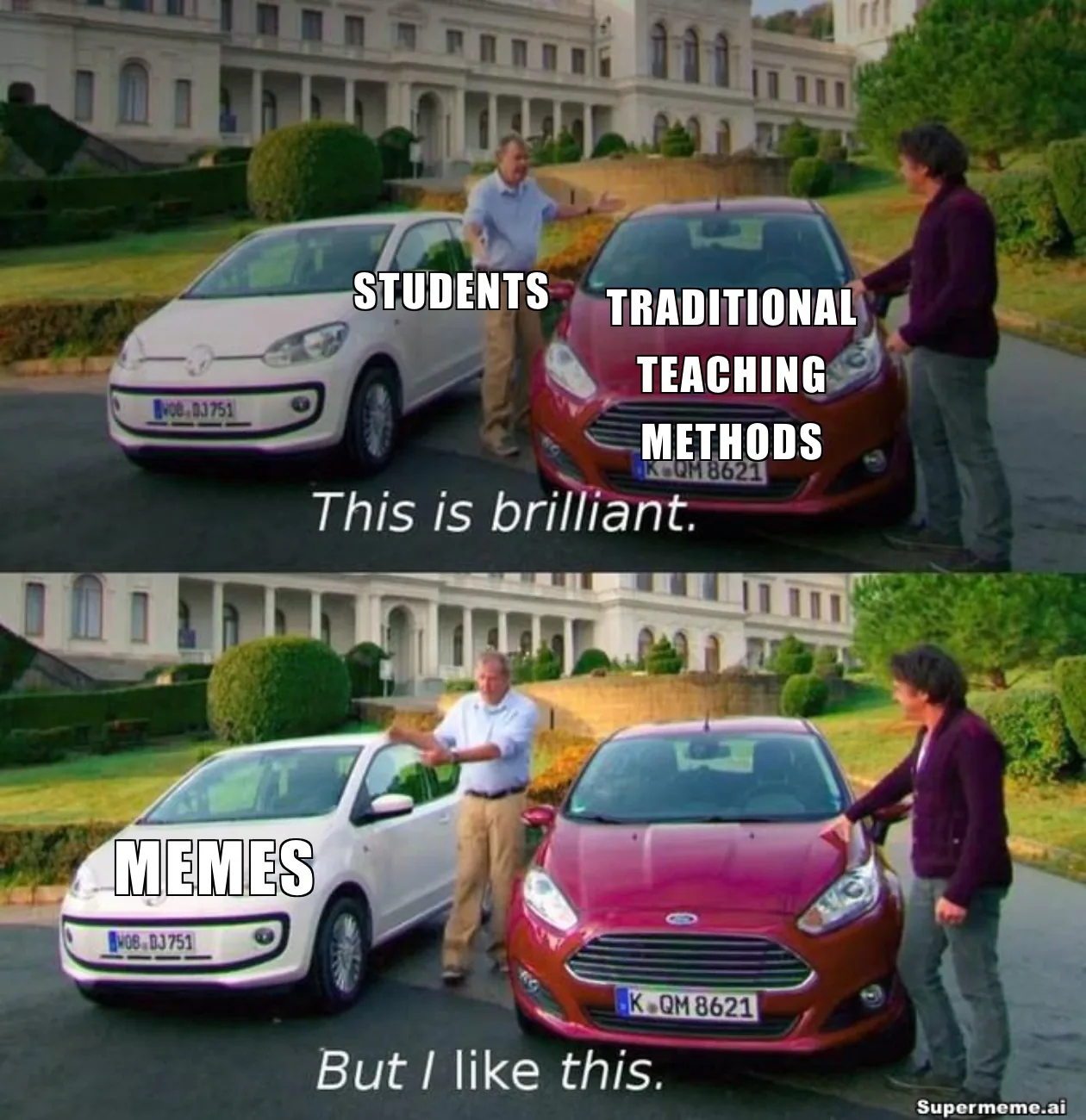
Two science examples to discuss
These existing images are prompts for a lesson. Use the questions alongside them; the captions cannot carry the explanation on their own.
Earth’s orbit: compare the two claims
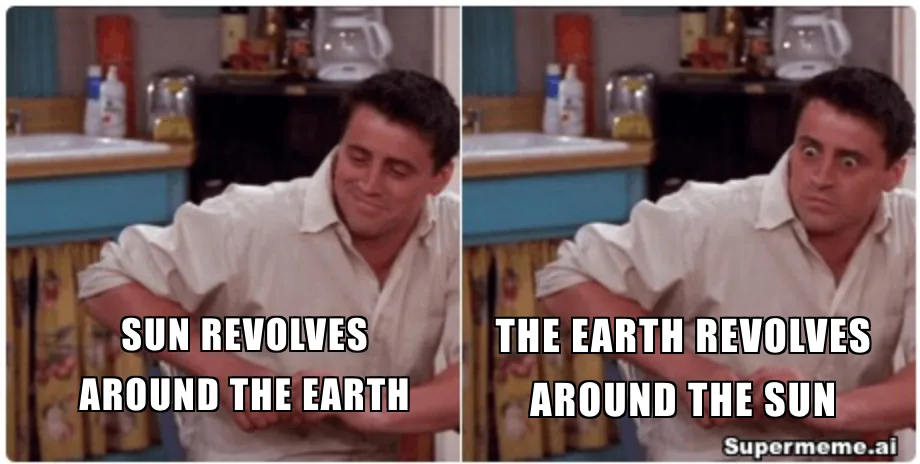
The left caption describes a geocentric claim: the Sun goes around Earth. The right caption gives the heliocentric comparison: Earth goes around the Sun. Ask students to choose the statement that describes Earth’s orbit and explain their choice.
Ask the class
Which statement describes Earth’s orbit? Draw and label the Sun and Earth, then sketch Earth’s path around the Sun.
Follow up with a separate question: how is Earth’s orbit different from its rotation on its axis? Earth’s orbit is its path around the Sun; its rotation is Earth spinning on its axis. Connect those motions to a year and a day.
Check the subject facts in NASA’s Earth facts.
The matching Joey editor starts with two placeholder captions. Replace them with your own text; this example’s science captions are part of the picture shown here.
Edit the Joey exampleNewton’s third law: critique the caption
This example shows a train striking a school bus. Preview it for your class before using it; you can use a diagram of two interacting objects instead.
Show the existing collision image
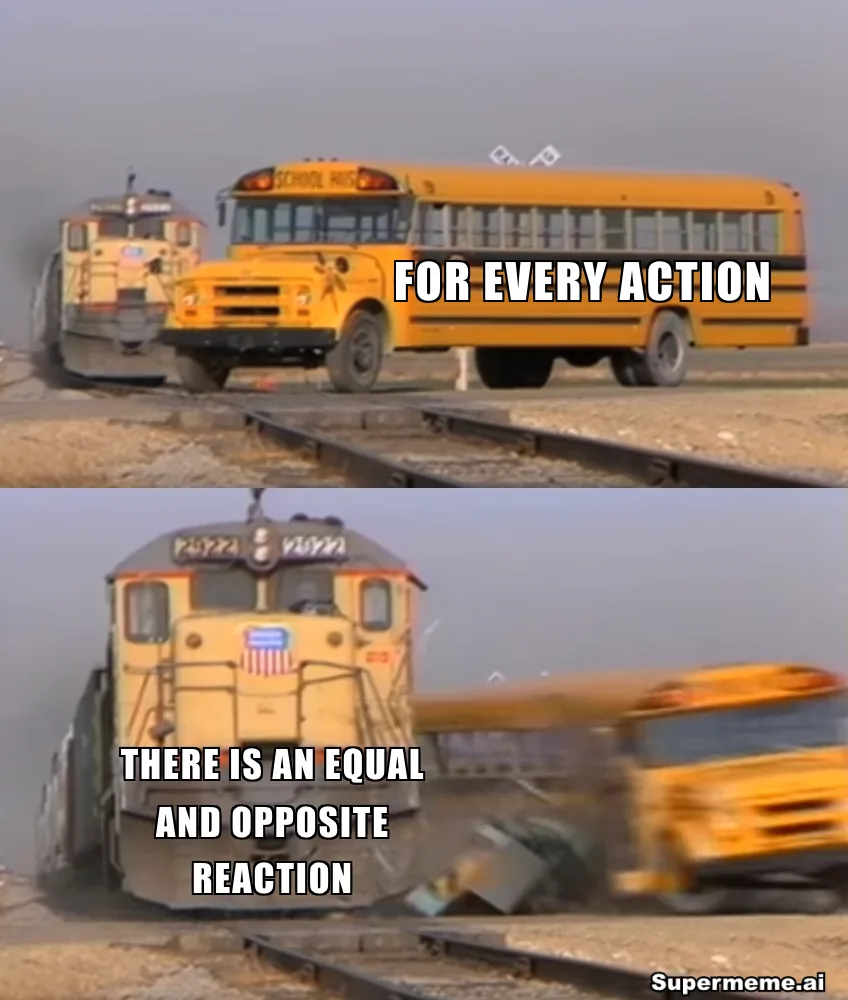
During contact, the train exerts a force on the bus and the bus exerts a force on the train. The paired forces have equal magnitude and opposite directions, and act on different objects. They occur together; the second picture is not a delayed “reaction” force.
Ask the class
Identify the train-on-bus force and the bus-on-train force. Which object does each force act on? Why don’t those forces cancel on one object?
Equal force does not mean equal movement or damage. Ask students what else they would need to know to explain the motion, including the objects’ masses and the other forces acting on them.
Use NASA’s explanation of Newton’s laws to check the force pair and its relationship to motion.
A classroom meme assignment
Choose a concept the class has already studied. Keep the task small enough that you can review the caption and explanation together.
Student task
Choose one idea from the lesson. Write a caption for a teacher-approved image, then add two or three sentences explaining how the image and words represent that idea. Name one thing the meme leaves out or simplifies.
Choose the lesson objective
Decide what students should explain, such as the difference between an orbit and a rotation. Review the facts and vocabulary they will need before asking for captions.
Model an explanation
Show an example you have checked. Explain how its image and words connect to the concept, and name a limit of the comparison. Invite students to question the caption.
Draft the caption and explanation
Let students work on paper or use an editor you manage. They can describe their proposed caption without creating a new tool account. Offer a diagram or short written explanation as another way to take part.
Check and revise
Read the explanation as well as the image. Ask the student to correct an inaccurate claim, explain an unclear connection or replace a reference the class would not understand. Review the revision before sharing it.
Ask a new question
Set the meme aside and ask students to apply the idea in a different context. For the astronomy activity, ask what motion explains a year on another planet. Use their answers to decide what to revisit.
What to look for in a submission
- Concept accuracy
- Does the caption make a correct claim? Does the explanation use the lesson’s terms correctly?
- A clear connection
- Can the student explain how the image and caption represent the idea, without relying on everyone knowing the joke?
- The comparison’s limits
- Can the student name something the meme simplifies, omits or could cause a reader to misunderstand?
Judge the explanation and subject accuracy. Being funny, knowing a television reference or making a polished image should not substitute for those checks.
For a slide-based version, plan the image, question and discussion with the meme presentation guide.
What does the teaching evidence say?
Biology instructor Karen K. Resendes describes students using memes to explain scientific concepts in her courses. Her firsthand classroom account offers an activity to adapt. It reports her experience and students’ responses, rather than a controlled test of achievement.
The Institute of Education Sciences’ teaching practice guide recommends pairing graphics with words, asking explanation questions and using quizzes to revisit content. That is general teaching guidance; it does not establish a special learning benefit from memes or from this tool.
A 2025 study of meme-based English lessons followed 91 Grade 10 pupils at one Philippine private school for eight weeks. Its results table found no statistically significant difference in gains between the groups. That study does not support a claim that memes always outperform other teaching methods.
Use the activity to hear students’ reasoning. Check their answers and later application of the concept, rather than treating laughter or a successful caption as proof of understanding.
Review the image and explanation before sharing
Check accuracy
Look for misleading labels, missing conditions and comparisons that imply the wrong cause. Read any AI-written caption as a draft and check it against the lesson’s sources.
Check the reference and audience
Preview the whole image, its usual meaning and the caption for the intended age and class. Avoid jokes aimed at a student or group. A familiar format in one class may need an explanation in another.
Make the task readable
Use text large enough for the classroom display. Supply the caption and an explanation in text, and describe the relevant image details aloud. Let students participate without recognizing the character or reading the picture alone.
Review student work
Set the sharing rules before the task. Check submissions before projecting or publishing them, and follow your school’s rules for student names, photos and online tools.
For format and tone considerations, review template choices. The workplace guide is a starting point for selecting an image, not a classroom suitability check.
Before publishing outside the class, consider the rights to the image and other material. The meme copyright guide explains U.S. copyright questions; it does not clear an individual classroom or public use.
Make or find a meme for the activity
Start with an image you have reviewed, add a caption, then check the finished file at the size you will display it. The meme-making guide walks through editing text and exporting an image.
For a reaction that fits a lesson moment, try searching for Trying to understand something confusing. Review the results for your class before choosing one.
Suggested prompt for teacher drafting
I’m teaching Earth’s rotation and its orbit around the Sun. Students mix up a day and a year.
You can try this prompt in the AI meme generator. It is a proposed input, not the prompt that produced the existing pictures on this page. Check each suggested image, scientific claim and caption before using it.
Questions about teaching with memes
How can I use a meme as a classroom assignment?
Ask students to caption a reviewed image about one lesson idea, explain the connection in two or three sentences and name a limit of the comparison. Review their reasoning, ask for revisions where needed and follow with a separate application question.
Does a funny meme show that a student understands the topic?
A funny caption alone cannot show that. Ask the student to explain the subject claim and the image’s connection to it. Check for errors and ask another question that uses the same idea in a new context.
Do students need an AI tool or an account to take part?
No tool account is needed for the assignment described here. Students can draft a caption and explanation on paper or suggest text for an editor the teacher manages. AI drafting is an optional teacher workflow; check any resulting image and wording before class.
What if students do not know the meme reference?
Explain the relevant image details and supply the caption in text. Allow a diagram or short written explanation instead. Assess the lesson idea and reasoning, rather than familiarity with a character, joke or template.
Written by
Sanjeev NCCo-founder of Supermeme.ai. Building the default meme generator of the internet since 2022.